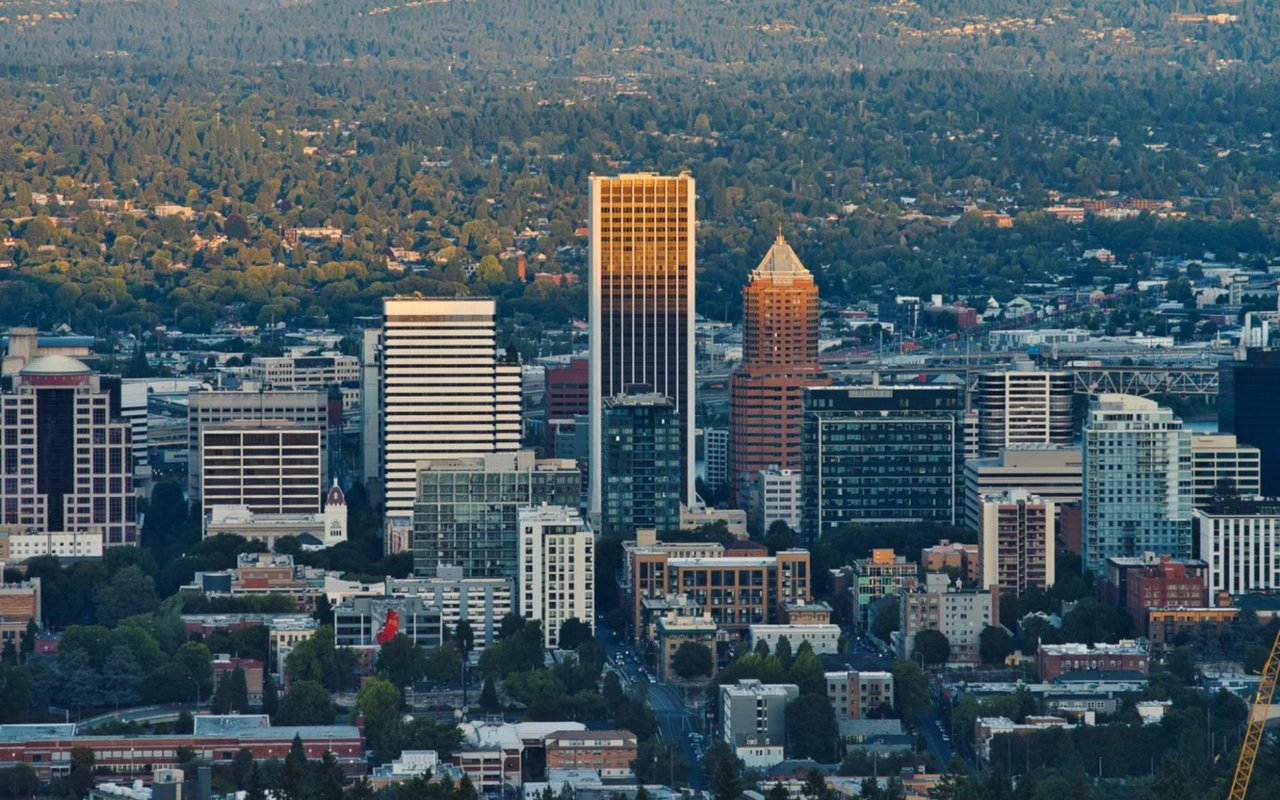
Portland, Oregon sits at the confluence of the Willamette and Columbia Rivers in Multnomah County, anchoring a metropolitan area of roughly 2.51 million people. The city proper holds about 630,000 to 635,000 residents across 94 officially recognized neighborhood associations — a number that surprises most people relocating here, and one that explains why choosing where to live in Portland feels harder than choosing whether to move here at all.
The market itself has settled into a genuinely different rhythm than the one that defined the 2015 to 2022 stretch. Citywide median home prices now sit between roughly $530,000 and $568,000, with year-over-year movement essentially flat — somewhere between a 0.1% and 0.7% decline depending on whether you're measuring list prices or closed sales. Metro population has contracted slightly, around 0.7% annually in recent years, after decades of rapid expansion. Homes take about 61 days from listing to close, though the median time to go pending is closer to 13 days, which tells you something important: well-priced homes in desirable neighborhoods still move quickly, while overpriced inventory sits.
For buyers, this is a materially better environment than the frenzy of a few years ago. You have time to see a house twice. Inspection contingencies survive. Sellers negotiate. But the flat headline number conceals enormous variation between neighborhoods — median prices in this guide range from roughly $420,000 in the Pearl District to $950,000 in Alameda, and the strategic question isn't whether Portland is affordable but which Portland you're buying into.
This guide covers fifteen neighborhoods with the data buyers actually need: median prices, days on market, assigned schools by name, walkability and transit scores, and real commute times to downtown. It also covers what most neighborhood guides skip — the tax structure, the safety picture, and the cross-river alternatives in Southwest Washington that a meaningful share of Portland-area buyers end up choosing instead.
Is Portland, Oregon a Good Place to Live?
An honest answer requires separating Portland's reputation from Portland's numbers, because the two have drifted apart in both directions.
The case for Portland
No sales tax. Oregon levies no state or local general sales tax. For households where consumer spending represents a large share of the budget — furnishing a home, buying a car, replacing appliances — this is a real and immediate savings.
The rain is misunderstood. Portland averages roughly 36 to 43 inches of annual rainfall, which is actually less than New York City (~47 inches), Atlanta (~50 inches), or Miami (~67 inches). What Portland does have is about 153 days per year with measurable precipitation. The rain isn't heavy; it's persistent. Overcast skies, light drizzle, and mist across many months rather than dramatic storms. Whether that's a dealbreaker or a feature is genuinely personal, and it's worth spending a February here before committing.
Housing inventory with actual character. Portland's inner eastside was largely built between 1890 and 1940, which means Craftsman bungalows, Victorians, English cottages, four-squares, and Tudors on tree-lined grids. If you want a house with original millwork and a front porch rather than a builder-grade box, this is one of the best markets in the country for it.
Walkability and bikeability at a level few American cities match. Multiple neighborhoods in this guide carry Walk Scores above 90 and Bike Scores above 95. The MAX light rail, streetcar, and bus network genuinely function for daily commuting in the inner neighborhoods.
Median household income around $91,000 to $91,500 in the city proper, with metro-area median family income near $128,300 for a family of four.
The case against, or at least the case for going in informed
Cost of living runs about 19% above the national average, with a composite index near 119.3. Housing is the primary driver, followed by state and local income taxes. Lower utility rates and zero sales tax offset some of this, but not all of it.
The income tax picture is the single most underestimated factor for relocating buyers. Oregon's graduated state income tax runs from 4.75% to 9.90%, with the top marginal rate applying to individual income above roughly $125,000 (or $250,000 for married filing jointly). Layered on top of that, if you live in Portland:
- Portland Arts Tax: a flat $35 per year for every resident 18 or older with income above the federal poverty level
- Metro Supportive Housing Services (SHS) Tax: 1.0% on taxable income above $125,000 for single filers, $200,000 joint
- Multnomah County Preschool for All (PFA) Tax: 1.5% on taxable income above $125,000 single / $200,000 joint, rising to 3.0% on individual income above $500,000
Stacked together, a high earner living in Multnomah County can face a combined top marginal state and local personal income tax rate exceeding 14.4%. If your household income is in that range, this number should factor into your neighborhood search as heavily as school ratings — and it's the primary reason a substantial number of Portland-area buyers look north across the Columbia River. More on that below.
Downtown is still recovering. Office vacancy in the downtown core and Central Business District remains elevated at roughly 29% to 30%, though direct vacancy has begun to stabilize rather than continue deteriorating. Daytime foot traffic is rebounding as hybrid return-to-office policies take hold, but evening and weekend pedestrian volumes still trail pre-2020 levels. If your vision of Portland involves a bustling downtown, calibrate expectations. If you're buying in the inner eastside neighborhoods where most of this guide focuses, downtown's condition affects your commute and your dining options but not your daily street life.
Understanding Portland's Quadrant System
Portland addresses are organized into six sectors, and understanding the logic makes the entire city legible.
Two baselines do the work. The Willamette River divides the city east from west. Burnside Street divides north from south. That yields the four traditional quadrants — Northwest, Northeast, Southwest, Southeast. North Williams Avenue then separates North Portland from Northeast Portland, creating a fifth sector. South Portland, formally designated in 2020, is the sixth.
What this means in practice:
Northwest Portland covers the Pearl District, the Alphabet District, Nob Hill, and Forest Park. Dense, walkable, historically wealthy in the West Hills, and home to the city's highest concentration of condo inventory.
Southwest Portland contains downtown, the South Waterfront, and then climbs into the West Hills toward Hillsdale, Multnomah Village, and Bridlemile. Steep topography, larger lots, more mid-century inventory, and the lowest crime volumes in the city.
Northeast Portland holds the historic streetcar suburbs — Irvington, Alameda, Laurelhurst, Beaumont-Wilshire — plus the Alberta Arts District and Hollywood. This is where Portland's grandest early-twentieth-century architecture concentrates.
Southeast Portland runs from the inner Hawthorne, Belmont, and Division corridors out through Mt. Tabor, Woodstock, Sellwood-Moreland, and Montavilla. The largest and most varied sector, spanning some of the city's most expensive and most affordable inventory.
North Portland includes St. Johns, Kenton, Portsmouth, and University Park. Historically industrial, increasingly the value play, and connected downtown by the MAX Yellow Line.
South Portland covers the South Waterfront and Lair Hill — the newest construction in the city, with high-rise condos, OHSU medical campus access, and aerial tram service.
Portland Neighborhood Comparison
Neighborhood | Sector | Median Price | Walk Score | Downtown Commute | Best For |
|---|---|---|---|---|---|
Pearl District | NW | ~$420,000 | 97 | 5 min drive | Urban professionals, condo buyers |
Nob Hill / Alphabet | NW | ~$580,000 | 96 | 7 min drive | Walkability, historic character |
Alberta Arts | NE | ~$650,000 | 89 | 15 min drive | Creatives, young professionals |
Irvington | NE | ~$890,000 | 86 | 10 min drive | Historic grandeur, families |
Alameda | NE | ~$950,000 | 72 | 12 min drive | Families, top schools |
Beaumont-Wilshire | NE | ~$720,000 | 78 | 15 min drive | Families, village main street |
Laurelhurst | NE/SE | ~$885,000 | 82 | 10 min drive | Families, park access |
Hawthorne / Belmont | SE | ~$650,000 | 93 | 10 min drive | Walkability, culture |
Sellwood-Moreland | SE | ~$570,000 | 84 | 12 min drive | Families, small-town feel |
Mount Tabor | SE | ~$680,000 | 70 | 15 min drive | Outdoor access, views |
Woodstock | SE | ~$510,000 | 78 | 18 min drive | First-time buyers |
Montavilla | SE | ~$465,000 | 76 | 15 min drive | Value, emerging corridor |
St. Johns | N | ~$440,000 | 75 | 20 min drive | Value, self-contained town feel |
Kenton | N | ~$460,000 | 77 | 15 min drive | First-time buyers, MAX access |
Multnomah Village | SW | ~$595,000 | 74 | 12 min drive | Families, larger yards |
The 15 Best Neighborhoods in Portland, Oregon
1. Pearl District (Northwest)
The Pearl is Portland's signature urban transformation — a former rail yard and warehouse district converted over three decades into the densest, most walkable residential neighborhood in the state. It carries a Walk Score of 97, Bike Score of 98, and Transit Score of 88, the highest combined mobility profile in Portland.
Housing here is almost entirely condominiums: industrial warehouse conversions with exposed brick and timber alongside mid- and high-rise glass towers built from the 1990s to the present. Median sale price sits near $420,000, with a range from roughly $275,000 for a studio to well past $1.2 million for a penthouse. Homes take about 45 to 60 days to sell — slower than the eastside, which reflects both the volume of comparable units and buyer caution around HOA costs.
That HOA point matters. Over 95% of Pearl District units carry monthly dues, typically $400 to $1,200 or more. Those dues often cover water, sewer, garbage, exterior maintenance, and building amenities, so the comparison against a single-family home's true carrying cost is less lopsided than the raw number suggests — but it needs to be modeled explicitly, not glossed over.
Assigned schools are Chapman Elementary, West Sylvan Middle, and Lincoln High. Zip code 97209.
Landmark anchors include Powell's City of Books at the neighborhood's southern edge, Jamison Square with its popular fountain that functions as an unofficial summer splash pad, and The Armory, home to Portland Center Stage. The Pearl also hosts First Thursday, the city's original gallery walk. Commute downtown is about five minutes by car, or five to ten via the Portland Streetcar NS Line or Bus Route 17.
Who it suits: professionals who want to eliminate a car, empty nesters downsizing from eastside houses, and buyers who value amenity and location over square footage and a yard.
2. Nob Hill / Alphabet District (Northwest)
Just northwest of the Pearl, the Alphabet District — named for its lettered cross-streets — offers what the Pearl doesn't: pre-war architecture at street scale. Victorians, Craftsmans, Edwardian double-foursquares, and historic brick apartment buildings from the 1890s through the 1930s line a tight walkable grid.
Median price runs about $580,000, spanning roughly $350,000 for condo conversions to $1.4 million for restored single-family homes. Days on market is a brisk 25 to 35 days. HOA prevalence is moderate, concentrated in the low-rise historic condo conversions rather than purpose-built towers.
Walk Score 96, Bike Score 94, Transit Score 72. Assigned schools match the Pearl: Chapman Elementary, West Sylvan Middle, Lincoln High. Zip codes 97209 and 97210.
The commercial life happens on NW 23rd and NW 21st Avenues — boutiques, restaurants, and the original Salt & Straw ice cream shop. Cinema 21 is one of the city's last great independent theaters, and Wallace Park anchors the residential core. Forest Park, at over 5,000 acres one of the largest urban forests in the country, begins a short walk uphill. Downtown is seven minutes by car, about twelve via Bus Route 15 or the streetcar.
Who it suits: buyers who want the Pearl's walkability with a historic house instead of a condo, and anyone who wants trailhead access from their front door.
3. Alberta Arts District (Northeast)
Alberta is the neighborhood that most defines contemporary Portland's creative identity. NE Alberta Street runs as a continuous commercial spine of galleries, coffee roasters, vintage shops, food cart pods, and independent restaurants, with residential blocks of Craftsman bungalows and English cottages from the 1900s through the 1940s on either side, plus modern infill rowhouses from the 2010s onward.
Median price is about $650,000, ranging roughly $450,000 to $875,000. Days on market is fast — 14 to 25 days — reflecting genuine competition for inventory here.
Walk Score 89, Bike Score 95, Transit Score 52. That transit number is the honest weak point: Alberta is superbly bikeable but transit-dependent commuters rely on Bus Route 72 connecting to the MAX Red or Blue lines, roughly 25 minutes to downtown, versus 15 minutes driving.
Assigned schools are Vernon K-8 or King K-8, feeding to Jefferson High or Grant High depending on the specific address — worth verifying at the block level, since the boundary matters. Zip code 97211. HOA prevalence is low, limited to infill townhome developments.
Anchors include the Alberta Rose Theatre, McMenamins Kennedy School (a converted 1915 elementary school now housing a hotel, restaurants, brewery, and soaking pool), and Alberta Park. Alberta hosts Last Thursday, the street's long-running monthly art event — distinct from the Pearl's First Thursday, and considerably more chaotic.
Who it suits: young professionals and creatives who want to be able to walk to dinner, and buyers who want a bungalow with character in a neighborhood with genuine street life.
4. Irvington (Northeast)
Irvington is one of Portland's oldest platted residential neighborhoods and the city's largest historic district. The housing stock — grand Craftsman, Colonial Revival, and Prairie-style homes from the 1890s through the 1930s — sits on wide, canopied streets with deep setbacks and mature landscaping. This is where Portland's early business elite built, and it shows.
Median price is $890,000, with a range from roughly $650,000 to well over $1.6 million. Days on market runs 18 to 30 days. HOA prevalence is very low.
Walk Score 86, Bike Score 96, Transit Score 61. Assigned schools are Irvington K-8 feeding to Grant High School, one of the strongest public high schools in the district. Zip code 97212.
Irving Park provides tennis courts, playgrounds, and open space at the neighborhood's eastern edge. The NE Broadway commercial corridor handles daily needs and dining. The annual Irvington Home Tour is worth attending if you're seriously considering the area — it's an unusually direct way to see what the interiors actually look like. Downtown is ten minutes by car, about eighteen via Bus Route 8 or 17.
One practical note for buyers: historic district designation carries review requirements for exterior alterations. If your plans involve significant facade changes, additions, or window replacement, understand the process before you write an offer.
Who it suits: buyers with the budget for a substantial historic home who want architectural significance, mature streets, and a strong assigned high school.
5. Alameda (Northeast)
Alameda sits on and around the Alameda Ridge, a geological feature left by Ice Age floods that gives the neighborhood its defining characteristic: elevation, and with it views across the city toward the West Hills and, on clear days, Mount Hood and Mount St. Helens.
It's the most expensive neighborhood in this guide, with a median near $950,000 and a range from roughly $750,000 to $1.8 million. Housing is custom Period Revival, Tudor, and Craftsman from the 1910s through the 1940s — larger and more architecturally ambitious than typical Portland bungalow stock. Days on market is 15 to 28 days. HOAs are essentially nonexistent.
Walk Score 72, Bike Score 82, Transit Score 48. These are the lowest mobility scores among the premium eastside neighborhoods, and that's the tradeoff: Alameda is quiet and residential precisely because it isn't a commercial corridor. Daily errands generally mean driving or a short trip to the Fremont or Beaumont business districts.
Assigned schools are Sabin K-8 or Alameda Elementary, then Beaumont Middle and Grant High School. Alameda Elementary carries a GreatSchools rating of 8/10; Grant High also rates 8/10. Zip codes 97211 and 97212.
The Alameda Elementary public staircase climbing the ridge is a genuine neighborhood landmark, and the NE Fremont Street district handles coffee, dining, and groceries. Downtown is twelve minutes by car, about 25 via Bus Route 12 or 75 to MAX.
Who it suits: families with the budget to buy at the top of the eastside market who prioritize schools, house size, and quiet over walkability.
6. Beaumont-Wilshire (Northeast)
Beaumont-Wilshire delivers much of what makes Alameda desirable at roughly 75% of the price. Median sits at $720,000, ranging about $525,000 to $1.1 million, with housing consisting of English cottages, Craftsman bungalows, and Cape Cods from the 1920s through the 1950s. Days on market is 16 to 30 days, and HOAs are very rare.
Walk Score 78, Bike Score 84, Transit Score 46. Assigned schools are Alameda Elementary (8/10), Beaumont Middle, and Grant High (8/10) — the same feeder pattern as Alameda, which is the central value argument for this neighborhood. Zip codes 97212 and 97213.
Wilshire Park is one of the better neighborhood parks in Northeast Portland, with substantial tree canopy and open lawn. The Beaumont Village commercial stretch along NE Fremont between roughly 41st and 46th is compact but complete — grocery, coffee, restaurants, and Pip's Original Doughnuts & Chai, which has a devoted following. Downtown runs fifteen minutes driving, about 30 via Bus Route 12.
Who it suits: families who want Alameda's school assignment and street character without Alameda's price, and buyers who value a real village center over a longer commercial corridor.
7. Laurelhurst (Northeast / Southeast)
Laurelhurst was master-planned in 1909 as a curvilinear garden suburb, and it still reads differently from the surrounding grid — winding streets, traffic circles, and intentional landscaping. Housing is historic Craftsman, Spanish Colonial, and Tudor from the 1910s through the 1930s, generally on generous lots.
Median price is $885,000, ranging roughly $650,000 to $1.5 million. Days on market is a quick 14 to 25 days. HOA prevalence is low.
Walk Score 82, Bike Score 93, Transit Score 60. Assigned schools are Laurelhurst K-8 feeding to Grant High School. Zip codes 97214 and 97232.
Laurelhurst Park, 31 acres with a spring-fed duck pond, is one of Portland's most beautiful public spaces and the neighborhood's defining amenity. The Sandy Hut on NE Sandy is a beloved dive bar and a useful reminder that Laurelhurst borders a busy arterial. Commute is about ten minutes driving, or roughly fifteen via MAX Blue, Green, or Red lines from the Hollywood/NE 42nd station — the best transit access of any premium eastside neighborhood.
Who it suits: families who want park frontage and a garden-suburb layout while keeping genuine light rail access to downtown.
8. Hawthorne / Belmont (Southeast)
If one neighborhood defines Portland's public image, it's Hawthorne. SE Hawthorne Boulevard runs as a nearly unbroken commercial corridor of vintage clothing shops, record stores, bookstores, bars, and restaurants, with SE Belmont Street doing something similar a few blocks north.
Housing is among the oldest in the city — Victorians, Craftsman bungalows, and four-squares from the 1890s through the 1920s. Median price is $650,000, ranging roughly $475,000 to $950,000. Days on market is the fastest in this guide at 10 to 20 days, which tells you how much demand concentrates here.
Walk Score 93, Bike Score 98, Transit Score 58. The Bike Score of 98 is effectively the ceiling — Hawthorne and Belmont sit at the center of Portland's most developed cycling infrastructure.
Assigned schools are Sunnyside Environmental K-8 or Glencoe Elementary, then Mt. Tabor Middle and Franklin High. Zip code 97214. HOA prevalence is low.
Anchors include the Bagdad Theater (a 1927 McMenamins movie palace), House of Sound, and the western slope of Mt. Tabor Park. Commute downtown is about ten minutes by car, roughly eighteen via Bus Route 14 along Hawthorne or Route 15 along Belmont.
Two honest caveats. First, houses from the 1890s and 1900s frequently come with original knob-and-tube wiring, cast-iron plumbing, unreinforced masonry foundations, and no seismic bracing — budget for inspection findings and plan for upgrade costs. Second, living directly on Hawthorne Boulevard means street noise and limited parking. A block or two off the corridor gets you the access without the friction.
Who it suits: buyers who want maximum walkability and cultural density in a real house, and who are prepared for the maintenance realities of century-old construction.
9. Sellwood-Moreland (Southeast)
Sellwood-Moreland functions almost like a separate small town appended to Portland's southern edge — which is historically accurate, since Sellwood was an independent city until 1893. The neighborhood combines Victorians, Craftsman bungalows, and mid-century cottages from the 1880s through the 1940s on quiet, heavily treed streets.
Median price is $570,000, ranging roughly $420,000 to $900,000 — notably more accessible than the comparable NE historic neighborhoods. Days on market runs 20 to 35 days, slower than Hawthorne or Alberta, which gives buyers more room to negotiate. HOA prevalence is low.
Walk Score 84, Bike Score 88, Transit Score 48. The transit score understates the practical reality: the MAX Orange Line puts downtown about twenty minutes away, and driving takes twelve.
Assigned schools are Llewellyn Elementary (GreatSchools 8/10), Sellwood Middle, and Cleveland High School. Zip code 97202 — which, incidentally, appears in search data on its own, suggesting people are researching this area by zip.
Amenities are genuinely strong for families: Oaks Amusement Park (a century-old riverfront amusement park with a historic roller rink), Sellwood Riverfront Park, Sellwood Park, and the adjacent Oaks Bottom Wildlife Refuge with its trail network. The Moreland Theater and the antique shopping district along SE 13th Avenue give the commercial core its character.
Who it suits: families who want a self-contained, walkable neighborhood with riverfront green space and strong schools, at a meaningful discount to Northeast Portland's premium districts.
10. Mount Tabor (Southeast)
Mount Tabor is built on the flanks of an extinct volcanic cinder cone — one of very few within an American city's limits. That topography delivers the neighborhood's signature: elevation, views, and a 190-acre park at the summit.
Housing is mid-century modern, Craftsman, and English cottage from the 1920s through the 1960s, a broader range than the strictly pre-war inner neighborhoods. Median price is $680,000, roughly $500,000 to $1.1 million. Days on market is 15 to 28 days. HOAs are very rare.
Walk Score 70, Bike Score 82, Transit Score 50. The lower walk score is partly a function of the hill — errands that would be a flat ten-minute walk elsewhere are a climb here.
Assigned schools are Glencoe or Atkinson Elementary, then Mt. Tabor Middle and Franklin High. Zip code 97215.
Mt. Tabor Park is the draw: the historic open reservoirs, the summit amphitheater, miles of trails, and a car-free day every Wednesday. Coava Coffee Roasters anchors the neighborhood's coffee culture. Downtown is fifteen minutes driving, about 25 via Bus Route 15 or 71 to MAX.
Who it suits: buyers who want park and trail access from their doorstep, and those drawn to mid-century inventory that's harder to find in the inner eastside.
11. Woodstock (Southeast)
Woodstock is one of the clearest value propositions in Portland proper — a complete neighborhood with a functioning commercial main street, well below the citywide median. Median price is $510,000, ranging roughly $380,000 to $725,000, with housing consisting of post-war ranches, Craftsman bungalows, and modern infill from the 1920s through the 1950s plus 2010s construction.
Days on market runs 18 to 32 days. HOA prevalence is very low. Walk Score 78, Bike Score 85, Transit Score 44.
Assigned schools are Woodstock Elementary, Hosford Middle, and Cleveland High School. Zip code 97206. Woodstock Elementary operates a Mandarin immersion program, which draws families from outside the boundary.
The SE Woodstock Boulevard commercial strip covers real daily needs — Grand Central Bakery, Otto's Sausage Kitchen (a neighborhood institution since 1929), a New Seasons Market, and a strong lineup of independent restaurants. Woodstock Park provides the green space, and Reed College sits immediately adjacent, lending the area a quiet academic edge. Downtown is eighteen minutes driving, about 32 via Bus Route 19 or 75 — the longest transit commute among the inner southeast neighborhoods, and the main tradeoff for the price.
Who it suits: first-time buyers and families who want a complete neighborhood with good schools and are willing to accept a longer commute for it.
12. Montavilla (Southeast)
Montavilla — short for Mount Tabor Villa — offers the lowest median price of any neighborhood in this guide at $465,000, with a range of roughly $350,000 to $650,000. Housing is mid-century ranches, Craftsman bungalows, and storybook cottages from the 1920s through the 1960s, often on larger lots than the inner eastside provides.
Days on market runs 20 to 35 days, giving buyers real negotiating room. HOA prevalence is minimal. Walk Score 76, Bike Score 86, Transit Score 58 — that transit score is actually stronger than several far more expensive neighborhoods, thanks to MAX proximity.
Assigned schools are Vestal Elementary, Harrison Park Middle, and McDaniel High School. Zip code 97216.
The SE Stark Street commercial corridor is Montavilla's story — an emerging strip that's added coffee shops, restaurants, a farmers market, and bars over the past decade without yet pricing out its residents. The Academy Theater (a restored 1948 movie house with a full menu), The Bipartisan Cafe, and Berrydale Park anchor the neighborhood. Downtown is fifteen minutes driving, about 25 via MAX Blue, Green, or Red from Gateway or the 82nd Avenue station.
Who it suits: buyers who want the most house and the most lot for the money inside city limits, and who are comfortable buying in a neighborhood still in the middle of its trajectory.
13. St. Johns (North)
St. Johns is the most physically distinct neighborhood in Portland — a former independent city on the Willamette peninsula, separated from the rest of North Portland by industrial land and connected to Northwest by the St. Johns Bridge, a 1931 Gothic-revival suspension span that's arguably the most beautiful piece of infrastructure in the state.
Median price is $440,000, ranging roughly $320,000 to $625,000. Housing consists of Craftsman cottages, Capes, and mid-century starter homes from the 1900s through the 1950s. Days on market runs 25 to 40 days, the slowest in this guide — which means the most buyer leverage. HOA prevalence is very low.
Walk Score 75, Bike Score 82, Transit Score 45. The honest constraint here is the commute: twenty minutes driving, and roughly 40 minutes via Bus Route 4 or 44 with no light rail access. If you work downtown five days a week without a car, this is a real cost.
Assigned schools are James John Elementary, George Middle, and Roosevelt High School. Zip code 97203.
Cathedral Park, sitting directly beneath the bridge's soaring piers, is the neighborhood's centerpiece and hosts a well-regarded summer jazz festival. The St. Johns Theater & Pub and a genuine downtown core along N Lombard Street give the area a small-town completeness that few Portland neighborhoods match. Pier Park and Forest Park trail access are both nearby.
Who it suits: value-focused buyers who want a distinct community identity and don't need a fast downtown transit commute.
14. Kenton (North)
Kenton is North Portland's strongest first-time-buyer proposition, largely because of one thing: the MAX Yellow Line runs straight through it, putting downtown about 25 minutes away by rail and fifteen by car. For a neighborhood with a $460,000 median, that transit access is unusual.
Housing ranges from Victorian farmhouses and Craftsman bungalows to WWII-era cottages, spanning the 1900s through the 1940s, with prices from roughly $340,000 to $640,000. Days on market is 20 to 35 days. HOA prevalence is minimal.
Walk Score 77, Bike Score 91, Transit Score 53. Assigned schools are Kenton Elementary, Ockley Green Middle, and Jefferson High School. Zip code 97217.
The 31-foot Paul Bunyan statue on N Interstate is a registered historic landmark and the neighborhood's unmistakable symbol. The commercial strip along N Denver Avenue has developed into a legitimate destination — Posies Bakery & Cafe among the anchors — and Kenton Park provides the green space.
Who it suits: first-time buyers who need transit access and want to stay under $500,000, and cyclists (that Bike Score of 91 is the highest in North Portland).
15. Multnomah Village (Southwest)
Multnomah Village is Southwest Portland's answer to the eastside's walkable main streets — a compact historic commercial core surrounded by residential blocks with larger lots and more mature tree cover than the eastside grid allows.
Median price is $595,000, ranging roughly $425,000 to $850,000. Housing is mid-century ranches, Craftsman cottages, and custom modern infill from the 1930s through the 1970s. Days on market runs 18 to 30 days. HOA prevalence is low to moderate.
Walk Score 74, Bike Score 55, Transit Score 40. That Bike Score is the lowest in this guide by a wide margin, and it's not a data artifact — Southwest Portland's hills and incomplete street grid make cycling genuinely harder than anywhere on the eastside. Plan accordingly.
Assigned schools are Maplewood Elementary, Gray Middle, and Ida B. Wells-Barnett High School (GreatSchools 8/10) — a strong feeder pattern and a significant part of the neighborhood's appeal. Zip code 97219.
The Multnomah Arts Center, housed in a former school, offers extensive community classes. Gabriel Park is one of the largest parks in Southwest Portland, with sports fields, off-leash areas, and trails. The Lucky Labrador Public House and the village's antique shops and restaurants along SW Capitol Highway give the core its character. Downtown is twelve minutes driving — faster than several eastside neighborhoods — or about 25 minutes via Bus Route 44 or 45.
Who it suits: families who want a larger yard and a strong high school assignment while keeping a short drive to downtown, and buyers drawn to Southwest Portland's quieter, greener character.
Best Portland Neighborhoods for Families
Laurelhurst and Alameda (Northeast) are the conventional answers, and the data supports them. Both offer stable, heavily treed residential streets, spacious historic homes, and strong community engagement. The school feeder pattern is the real draw: Alameda Elementary (8/10), Beaumont Middle, and Grant High School (8/10). The tradeoff is price — expect to start near $650,000 in Laurelhurst and $750,000 in Alameda.
Sellwood-Moreland (Southeast) may be the best overall value for families in the city. It combines a genuinely self-contained small-town atmosphere with riverfront green space at Oaks Bottom Wildlife Refuge and Sellwood Riverfront Park, walkability along SE 13th Avenue, and a solid school assignment in Llewellyn Elementary (8/10) feeding to Cleveland High School — all at a $570,000 median.
Multnomah Village (Southwest) suits families who want a suburban-urban hybrid: larger yards, direct access to Gabriel Park, a walkable village core, and a feeder path into Ida B. Wells-Barnett High School (8/10).
Beaumont-Wilshire deserves mention as the efficiency play — the Alameda school assignment at a $720,000 median rather than $950,000.
Best Portland Neighborhoods for Young Professionals
The Pearl District (Northwest) is the urban anchor. High-density condo living with the city's best walkability, immediate streetcar access, and the shortest commute to downtown finance, tech, and the corporate campuses of Nike and Adidas. The $420,000 median makes entry more achievable than most eastside single-family inventory.
Nob Hill / Alphabet District (Northwest) blends the commercial energy of NW 23rd and 21st Avenues with character-rich historic apartments and condo conversions. Particularly well suited to hybrid workers who want a pedestrian-centric daily life and Forest Park trail access on weekends.
Alberta Arts District and Kerns (Northeast) are the cultural picks — independent coffee, galleries, music venues, and food cart pods within walking distance. Alberta at a $650,000 median generally means buying a bungalow rather than a condo, so it suits professionals ready for homeownership at that level rather than first-apartment buyers.
Most Walkable Portland Neighborhoods
Pearl District — Walk Score 97. Daily errands genuinely require no car. Whole Foods, Trader Joe's, health clubs, galleries, and parks including Jamison Square and Tanner Springs all sit within a five-minute radius.
Nob Hill / Alphabet District — Walk Score 96. An exceptionally walkable historic grid with boutique retail, independent dining, groceries, and quick transit access along the NW corridors.
Hawthorne / Belmont — Walk Score 93. Vintage shops, grocers, theaters, and neighborhood cafes along two parallel commercial corridors, plus the best cycling infrastructure in the city at a Bike Score of 98.
Most Affordable Portland Neighborhoods
Montavilla (Southeast) at roughly $465,000 sits well below the citywide median while offering an emerging commercial stretch along SE Stark Street and MAX access.
Lents (Southeast) offers some of the lowest entry points inside city limits at roughly $380,000 to $420,000 — modest post-war starter homes, often on larger lots. Worth noting that Lents carries a higher relative crime volume than the neighborhoods profiled above; see the safety section.
Portsmouth and University Park (North) provide practical entry points around $400,000 to $440,000, below neighboring Kenton and Alberta, with proximity to the University of Portland and riverfront green space.
St. Johns (North) at $440,000 rounds out the list, with the added advantage of the slowest days-on-market in this guide and correspondingly more buyer leverage.
Best Portland Neighborhoods for First-Time Buyers
Kenton (North) — roughly $460,000 for single-family bungalows, a historic commercial strip along N Denver Avenue, and direct MAX Yellow Line access to downtown. The combination of price, house type, and transit is hard to match.
Woodstock (Southeast) — about $510,000 for post-war cottages and mid-century ranches in a neighborhood with a complete commercial core (Grand Central Bakery, New Seasons) and a strong school feeder pattern into Cleveland High.
St. Johns (North) — roughly $440,000, with a genuine downtown center, Cathedral Park, and the most negotiating room of any neighborhood in this guide. Accept the 40-minute bus commute and the value is real.
Best Portland Options for Retirees
Summerplace (Northeast) is Portland's primary established 55+ active adult master-planned community, offering single-level detached homes and attached townhomes with a dedicated clubhouse, tennis courts, and pool.
Courtyard Village at Raleigh Hills (Southwest) and Calaroga Terrace (Northeast) are premier independent and assisted living options, both offering maintenance-free living with proximity to major medical centers.
Rose Villa Senior Living (Southeast Waterfront) is a modern, eco-conscious nonprofit Continuing Care Retirement Community on the Willamette, notable for its zero-energy pocket-neighborhood cottages and urban-style lofts.
For retirees buying conventional homes rather than entering a community, the Pearl District and Multnomah Village consistently come up — the former for single-level condo living with everything walkable, the latter for single-level ranches with manageable yards near medical care.
Best Places to Live Near Portland, Oregon: Suburbs and the Cross-River Option
A significant share of buyers who begin searching in Portland proper end up buying outside it — and increasingly, across the Columbia River in Southwest Washington. Understanding why requires understanding the tax structure.
The Washington-Oregon tax dynamic
The state line running down the Columbia River creates one of the more consequential tax arbitrage situations in the country:
Washington residents pay 0% state income tax but 6.5% to 10.4% sales tax.
Oregon residents pay 0% sales tax but 4.75% to 9.90% state income tax, plus the Portland-area local surtaxes described earlier that can push a high earner's combined top marginal rate past 14.4%.
Who comes out ahead:
High earners and remote workers living in Washington capture the clearest advantage. No state income tax on their earnings, and because Oregon has no sales tax, Clark County residents routinely cross the river to make large purchases — appliances, furniture, vehicles — without paying sales tax on either side.
Cross-border commuters need to be careful. Washington residents who physically commute into Oregon for work do pay Oregon state income tax on income earned within Oregon. The exemption applies to remote employees living in Washington whose work is performed outside Oregon. If you work for a Portland company but work from your Vancouver home, you generally owe no Oregon income tax. If you drive to a Portland office three days a week, you owe Oregon tax on that portion. Verify your specific situation with a CPA before making a housing decision on this basis — the details matter and enforcement is real.
Oregon residents benefit when household income falls into the lower brackets, where income tax exposure is modest, or when consumer spending represents an outsized share of the household budget.
Suburb comparison
Suburb | State / Direction | Median Price | Commute to Downtown PDX | School District (GreatSchools) |
|---|---|---|---|---|
Lake Oswego | Oregon, south | ~$1,050,000 | 15–25 min | Lake Oswego SD (9/10) |
West Linn | Oregon, south | ~$825,000 | 20–30 min | West Linn-Wilsonville SD (8/10) |
Camas | Washington, I-205/SR-14 | ~$780,000 | 30–45 min | Camas SD (8/10) |
Happy Valley | Oregon, east | ~$730,000 | 25–40 min | North Clackamas SD (6–7/10) |
Ridgefield | Washington, I-5 north | ~$640,000 | 35–55 min | Ridgefield SD (7/10) |
Tigard | Oregon, southwest | ~$610,000 | 20–35 min | Tigard-Tualatin SD (6–7/10) |
Beaverton | Oregon, west | ~$580,000 | 15–25 min | Beaverton SD (6–8/10) |
Vancouver | Washington, I-5/I-205 | ~$500,000 | 20–45 min | Vancouver SD / Evergreen SD (5–7/10) |
Lake Oswego is the region's premier suburb — the strongest school district in the metro at 9/10, a lakefront setting, and a price point to match. West Linn offers a similar profile at a meaningful discount.
Camas, Washington has become the cross-river choice for buyers who want strong schools without Oregon income tax. The Camas School District rates 8/10, comparable to West Linn and Lake Oswego's neighbors, at a $780,000 median with no state income tax on the household's earnings. For a high-income remote worker, the annual difference against a comparable Lake Oswego purchase can be substantial.
Vancouver, Washington is the volume play at a $500,000 median — below Portland proper, with no state income tax, and a growing downtown and waterfront district. Commute ranges from 20 to 45 minutes depending on which bridge you use and when you cross.
Ridgefield, Washington is the fastest-growing city in Clark County, offering newer construction and a 7/10 school district at a $640,000 median, with the tradeoff of the longest commute on this list.
Beaverton remains the strongest Oregon-side value for commute time, at 15 to 25 minutes and a $580,000 median, with school ratings varying considerably by attendance area — worth verifying at the specific address.
The bridge factor: Interstate 5 Bridge Replacement
Anyone considering a cross-river purchase should understand the Interstate 5 Bridge Replacement (IBR) project, which will reshape the commute over the next decade.
- Scope: a $7.8 billion to $14.4 billion multi-modal corridor project replacing the twin drawbridges carrying I-5 across the Columbia River.
- Clearance: the U.S. Coast Guard has approved a 116-foot fixed-span design, eliminating the bridge lifts that currently halt I-5 traffic without warning.
- Transit: the new corridor extends Portland's MAX Yellow Line across the river directly into downtown Vancouver — a structural change to the cross-river commute.
- Tolling: open-road electronic tolling is slated to begin by 2028 to help fund construction.
- Timeline: Phase 1 procurement is active, with heavy construction breaking ground through 2026 to 2028.
For buyers, this cuts both ways. Long-term, light rail into downtown Vancouver and the end of bridge lifts materially improve the cross-river proposition and should support property values in Vancouver's core. Short-term, construction through the late 2020s means disruption, and tolling adds a recurring cost that should be modeled into any commute-dependent purchase.
Frequently Asked Questions
What are the safest neighborhoods in Portland? Statistically, the lowest crime volumes are found in the low-density West Hills and established inner-eastside enclaves. Leading neighborhoods include Alameda, Hillsdale, Bridlemile, Southwest Hills, and Eastmoreland. Verify any specific address using the Portland Police Bureau Open Data Crime Statistics Dashboard rather than relying on neighborhood-level generalizations.
What is the average home price in Portland, Oregon? The median home sale price across the Portland metro sits between $530,000 and $550,000. Single-family detached homes generally start in the mid-$500,000s, while townhomes start in the $400,000s and condos in the $300,000s. Within the city, neighborhood medians in this guide range from $440,000 in St. Johns to $950,000 in Alameda.
Is the Pearl District safe? The Pearl District is safe for everyday pedestrian living, but like most dense urban cores it experiences elevated property crime — vehicle break-ins, retail theft, and package theft in particular. Violent crime remains low relative to comparable urban commercial districts nationally. Secured parking, which most Pearl buildings include, addresses the most common issue.
What is the cheapest neighborhood in Portland? The most budget-friendly entry points are in Outer Eastside neighborhoods including Lents, Powellhurst-Gilbert, Centennial, and Hazelwood, where median prices range from $380,000 to $430,000. Inner-city affordable pockets include Montavilla (~$465,000) and St. Johns (~$440,000).
Which Portland neighborhoods are best for families? Alameda and Laurelhurst for high-performing schools (Alameda Elementary 8/10, Grant High 8/10) and spacious historic homes; Sellwood-Moreland for a walkable small-town atmosphere with riverfront parks and Llewellyn Elementary (8/10); and Multnomah Village for larger yards, Gabriel Park access, and Ida B. Wells-Barnett High School (8/10).
Is Portland, Oregon a good place to live? It depends heavily on your income level and your tolerance for two specific realities: high property crime and a heavy income tax burden if you earn above roughly $125,000. In exchange you get exceptional walkability and bikeability, distinctive pre-war housing stock, no sales tax, and immediate access to the Columbia River Gorge, the Coast, and Mount Hood. Cost of living runs about 19% above the national average.
Vancouver, WA vs. Portland, OR — which is better? Choose Vancouver, WA if you want 0% state income tax, lower baseline housing costs (~$500,000 median), and newer suburban development. It's strongest for remote workers and high earners who don't commute physically into Oregon. Choose Portland, OR if you prioritize short urban commutes, high walkability, 0% sales tax, distinctive historic housing inventory, and direct access to cultural amenities without crossing the Columbia River bridges.
How many neighborhoods does Portland have? Portland has 94 officially recognized neighborhood associations under the city's Office of Community & Civic Life, organized across six sectors: North, Northeast, Northwest, Southeast, Southwest, and South Portland.
Finding the Right Portland Neighborhood
Fifteen neighborhoods, a $530,000 differential between the least and most expensive, six sectors, and 94 neighborhood associations — the honest reality is that narrowing this down is difficult to do from a spreadsheet. The variables that end up mattering most are usually the ones that don't appear in listing data: whether the block has garages, how the school boundary runs down the middle of a street, what the actual commute looks like at 8 a.m. rather than at noon, and whether the tax math favors Oregon or Washington for your specific income structure.
That last question is where a dual-licensed perspective becomes genuinely useful rather than incidental.
David Merrick is a Certified Luxury Home Marketing Specialist and Realtor with Cascade Hasson | Sotheby's International Realty, licensed in both Oregon (#201226053) and Washington (#124951). With over nine years of experience across the Portland Metro and Southwest Washington markets, he works with buyers on both sides of the Columbia River — which means the Oregon-versus-Washington question gets answered on the merits of your situation rather than the limits of a license.
His credentials include the CLHMS Million Dollar Guild designation, Certified Residential Specialist (CRS), and Cartus Relocation Network Buyer and Marketing Specialist — the last being directly relevant if you're relocating into the region rather than moving within it. He was recognized with the Cascade Hasson | Sotheby's Gold Award for $15–$20 million in production in 2025, held Coldwell Banker International President's Circle from 2018 through 2023, and was named to the LGBTQ+ Real Estate Alliance Top 100 Agents in North America from 2021 through 2023.
If you're working through where to live in Portland — or weighing Portland against Vancouver, Camas, or Ridgefield — reach out. A conversation about your budget, commute, school priorities, and tax situation is more useful than another round of listing browsing.
David Merrick Cascade Hasson | Sotheby's International Realty 900 Washington Street, Suite 150, Vancouver, WA 98660 (360) 947-1625 [email protected]
Explore further: Portland, OR Real Estate · Portland Luxury Real Estate · Portland Condos · Vancouver, WA Real Estate · Camas, WA Real Estate · Ridgefield, WA Real Estate · Home Search · Home Valuation · Neighborhood Guides
Market data current as of September 2026. Home prices, days on market, and inventory conditions change continuously; contact David Merrick for current figures on any specific neighborhood or address. School ratings sourced from GreatSchools; attendance boundaries change and should be verified with Portland Public Schools for any specific property. Crime statistics sourced from Portland Police Bureau open data. Walk Score, Bike Score, and Transit Score are trademarks of Walk Score.